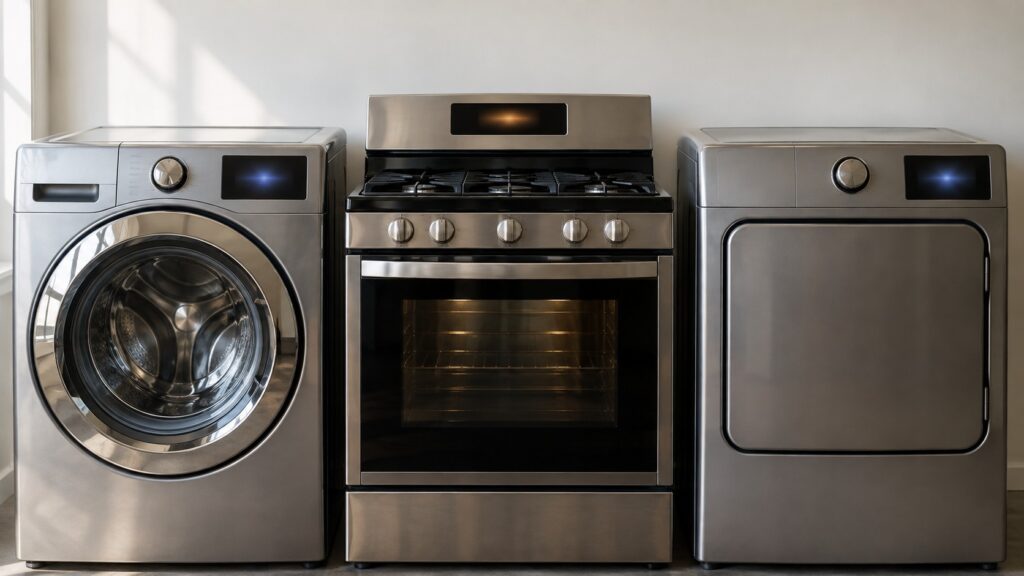
Electrolux error codes explained simply: the letter tells you which system reported the fault, and the number tells you which specific problem inside that system. An E code on a washer is not built the same way as an F code on a range, and treating every code as a single flat list is why so many people search a bare number and land on the wrong appliance’s page entirely.
What do the letters in an Electrolux error code mean?
The letter is the category, and the number is the entry inside that category. Electrolux does not reuse one flat numbering scheme across every appliance the way some brands do; instead, each appliance family has its own letter, and the number that follows only makes sense once you already know which letter and which machine you are reading. That is why “E5” on a dryer and “E5” on a cooktop describe entirely different problems: the letter looks the same, but the two number lists behind it were never the same list.
This matters most when you search a bare code online. A search for “E4” will surface pages for washers, dryers, and cooktops side by side, and only one of them describes your machine. Reading the letter and the appliance together, before the number, is the fastest way to skip the wrong pages.
How is an E code different from an EF code?
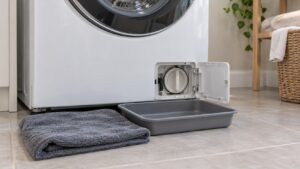
On Electrolux washers, plain E codes and EF codes both start with the same letter family but are not interchangeable. E-numbered codes tend to cover a broad range of electronic and mechanical faults — door sensing, drive faults, control communication. EF-numbered codes are reserved specifically for water: how much came in, how fast it drained, or whether the machine detected more water than it expected. If a washer’s display shows an EF code, the first thing worth checking is the water supply and the drain path, not the control board — that split is built into the naming on purpose.
Why do ranges and ovens use F codes instead of E codes?
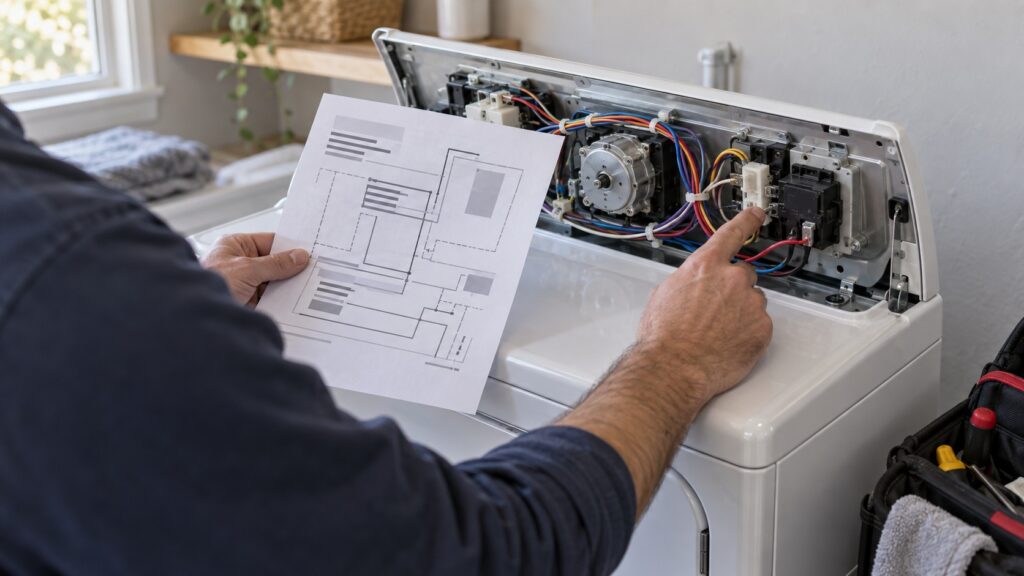
Electrolux ranges and wall ovens use F-prefixed codes for a reason tied to how the control system is built: these machines run a self-check on their own memory and on the sensors that read oven temperature, and F codes report the result of that self-check. F12 and F13, for example, both point at the control board itself — one at the microcontroller’s own self-test, the other at a memory checksum — while F30 and F31 point at the temperature probe circuit instead, open in one case and shorted in the other. The letter groups a fault by which system failed its check, not by how serious the fault is.
What does an H code mean on an Electrolux dryer?
H codes are specific to dryers, and they tend to describe problems that sit outside the normal wear parts of the machine. An H2 (sometimes displayed as B2) code points at the power supply feeding the dryer rather than anything inside it, and an H4 (or B4) code points at wiring that was connected incorrectly during installation. Both are worth knowing before assuming a dryer part has failed, because neither one is a part at all — one is a utility issue and the other is an installation issue that a technician corrects rather than replaces.
Does the same letter always mean the same thing on every Electrolux appliance?
No, and this is the single most common source of a wrong DIY diagnosis on this brand. E1 on a dryer is a thermistor reading out of range; E1 on a washer’s door-sensing family does not exist as a code at all, while E41 does. The letter is a category name that gets reused across appliance families because Electrolux, like every appliance maker, has more fault types than convenient single letters. Confirming the appliance first, then reading that appliance’s own code list, is the only reliable order of operations.
Why does the same number mean something different on two machines?
Each appliance’s control board runs its own diagnostic firmware, written by the engineering team responsible for that product line, not by one team writing a single fault-code standard for the whole brand. A washer’s control has no reason to know what a range’s F12 means, and a range’s control has no reason to know what a washer’s E44 means, because the two boards never share a fault table in the first place. That is also why a dryer’s H2 and a cooktop’s E-numbered fault can look superficially similar on a printed reference sheet and still describe completely unrelated hardware — the sheet groups codes by letter for convenience, not because the letter carries one consistent engineering meaning across every appliance category.
Knowing this changes how you should read a support forum or a used-parts listing, too. A comment that says “I had E4 on my Electrolux and replaced the thermistor” is only useful if that comment was about the same appliance type — a dryer, in this example — and the same generation of control board. The same comment about a washer’s E4-family code would be describing an entirely different repair.
Where can you look up a specific Electrolux code?
Once you know the appliance, go straight to that appliance’s code list rather than a general search. Our Electrolux dryer error codes guide covers the dryer’s E and H codes together, and our washer EF error guide and washer E44 error guide split the washer’s two families apart. For range and oven control-board codes, see our oven F90 error guide.
If you already have the exact code and appliance in hand and want a second opinion before ordering a part, schedule a visit and bring the display text with you — the plain-English message the machine shows alongside the code is often more useful than the code by itself. Electrolux error codes explained this way, letter first and appliance second, save more wasted parts orders than any other single habit in reading them.