An electrolux oven f90 error means the self-clean door-lock system failed to finish its locking or unlocking sequence. The oven is not reporting a temperature problem or a control fault — it is reporting that the motorized latch which seals the door during self-clean did not reach the position it was asked for. F90 usually arrives during or just after a self-clean cycle, and it frequently leaves the door locked shut, which is the part owners find alarming and the part that is working exactly as intended.
What does the F90 error mean on an Electrolux oven?
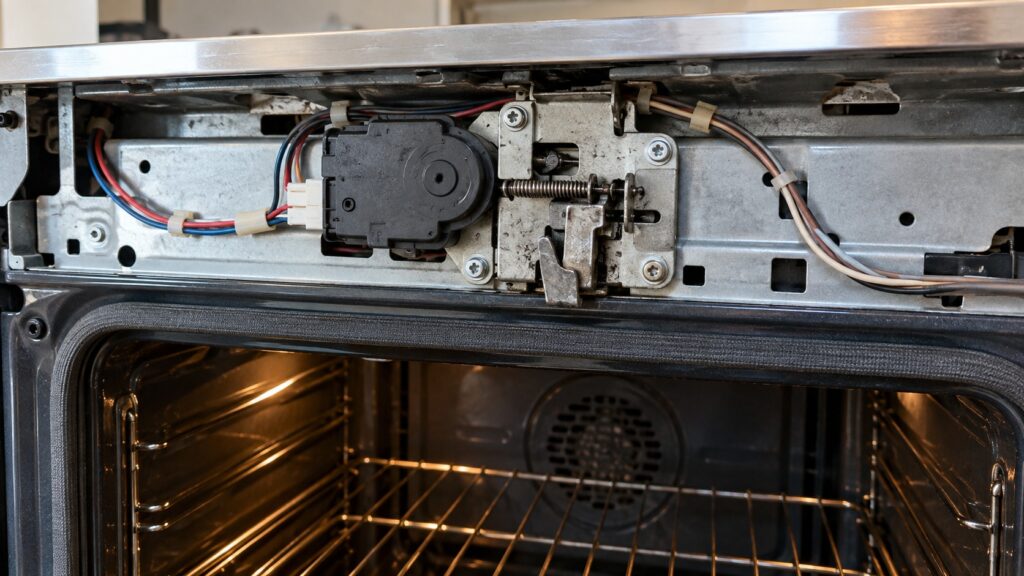
Self-clean runs the cavity far above any cooking temperature. At those temperatures an open door is genuinely dangerous, so the oven drives a small motor that throws a latch across the door and then confirms, through a micro-switch, that the latch actually arrived. The cycle does not begin until that confirmation exists, and the door does not release until the cavity has cooled and the same sequence has run in reverse.
F90 is what you see when the confirmation never comes. Either the latch did not move, or it moved and the switch did not report it. The control cannot tell the difference from the outside, so it refuses to proceed and holds the door in its current state. That is the safety interlock doing its job, not failing at it.
What do F91, F92, F93 and F94 add?
They are the same door-lock family, split by variant: a stalled lock motor as against a latch or micro-switch timing problem. All of them point at the same hardware, and the repair path is identical. If your display shows F92 rather than F90, nothing in this guide changes.
What the numbers do give a technician is a head start on which of the four parts to test first, which is why the exact code is worth writing down rather than reporting as “an F code”. The F90 code page lists the affected components and the severity we assign to it.
Why does the oven door stay locked?
Because the lock has only two safe states, and the oven will not leave a hot cavity in the unsafe one. If the fault happened at the start of self-clean, the latch may be partly across; if it happened at the end, the latch is fully across and the motor cannot retract it. Either way the oven keeps the door secured and reports the code rather than guessing.
The most common physical causes, in the order we find them:
- Stalled door-lock motor — the motor coil cannot drive the latch to the locked or unlocked position.
- Binding latch assembly — the mechanism is obstructed or mechanically worn after years of heat cycles.
- Failed micro-switch — the switch that confirms the locked or unlocked position is not reporting correctly.
- Wiring failure — the connection between the door-lock hardware and the control has broken, often where it passes a hot corner of the cavity.
What is safe to try yourself?
Two things, in this order, and then stop.
First, let the oven cool completely. Self-clean leaves a cavity hot for a long time, and many locks release on their own once the temperature sensor reads low enough. Give it several hours before concluding anything. Do not force the door, do not lever it, and do not pull on the handle while the cavity is still hot: the glass, the hinges and the latch all take damage, and the door itself weighs more than people expect when a hinge lets go.
Second, switch the wall oven off at the breaker for thirty seconds and restore power. A single power cycle re-runs the unlock sequence from a known state, and a timing fault sometimes clears there.
If F90 or a related code persists and the door will not release, that is the end of the owner-level path. The lock motor and switch sit above the cavity behind the control panel, in a space that carries line voltage and stays hot long after the cycle ends. This is a stop-and-call job, not a hidden-screw job.
How does F90 differ from F11, F12 and F13?
Electrolux groups its oven F codes by subsystem, and confusing the groups sends you after the wrong part.
The practical rule: the F90 family is mechanical and lives at the door, while F1 and F11 to F13 live on the control board. Our Electrolux oven F11 guide covers the control side, and if the code appeared on a freestanding range rather than a wall oven, the models and their faults are set out in our EI30EF range series guide.
What does a technician replace?
Diagnosis starts at the latch and works back. A technician checks whether the latch moves freely by hand once the oven is cold and isolated, tests the lock motor coil, tests the micro-switch for correct reporting in both positions, and inspects the wiring where it runs past the cavity. Parts are matched from the model and serial number, since the same lock assembly changed across production years.
One habit is worth adopting afterward: run self-clean less often, and never the day before you need the oven. Most of the F90 calls we take arrive the week of a holiday, from a household that started a four-hour cycle the evening before. Our self-clean tips explain how to keep the cavity in a condition that rarely needs the cycle at all.
When should you call for oven repair?
Call when F90 or any of F91 to F94 stays after the oven has cooled and been power cycled, when the door remains locked, when you can hear the lock motor running without the latch seating, or when the oven refuses normal cooking commands while the lock state is unresolved.
We are an independent repair company and not a factory service arm. Pricing starts from a diagnostic visit and we confirm the estimate before any work begins. Electrolux oven repair covers door locks, latches, switches, sensors and control boards on wall ovens and ranges. You can schedule a visit online or call (844) 414-1609.