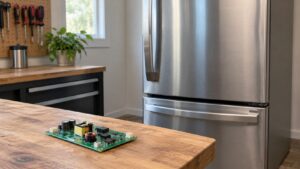
On a frost-free Electrolux refrigerator, the defrost system melts the frost that builds on the evaporator, the cold coil that cools the freezer, and sends the meltwater out to a pan where it evaporates. It does this on a repeating cycle, and it depends on a handful of parts working together: a defrost heater, a sensor that tells the control when the coil is clear, a control that starts and ends the cycle and a drain for the water. When one of them fails, frost and ice build up where they should not, which is why a freezer with a thick ice layer is usually a defrost problem rather than a cooling problem.
How does the defrost system on an Electrolux refrigerator work?
A refrigerator cools its freezer by pulling heat from the air through the evaporator. Moisture in that air freezes onto the coil as frost. A thin layer does no harm, but a thick layer blocks the airflow, and the freezer warms up. To prevent that, a No-Frost refrigerator runs a defrost cycle from time to time. During the cycle the cooling stops, a heater warms the coil, the frost melts and the water drains away. When a sensor reports that the coil is clear, the control ends the cycle and the cooling restarts.
The exact timing and the exact parts differ between models, so we describe the sequence in general terms rather than a fixed schedule. Our page on freezer frost and ice buildup says it plainly: on No-Frost models, heavy frost can point to a failed defrost control board, whereas some frost is normal on manual-defrost Low Frost models between defrost cycles.
What does the defrost sensor do?
The defrost sensor is a small temperature sensor mounted near the evaporator. Its job is to tell the control how warm the coil is. While the defrost heater is on, the sensor reads the rising temperature, and when it reports that the coil is warm enough, the control ends the cycle. If the sensor reads wrong, the cycle can end too early and leave frost on the coil, or it can run too long and warm the freezer. This is the reason people ask whether a defrost sensor can cause ice accumulation in a freezer: it can, because the cycle stops before the frost is gone, and the next layer of frost grows on top of the leftover ice.
A sensor is not a part you can test by feel. A technician checks it with a meter. Do not remove the rear panel of the freezer yourself, because the heater and its wiring sit behind it, and the heater is wired to household voltage.
Why is there ice in the freezer of an Electrolux refrigerator?
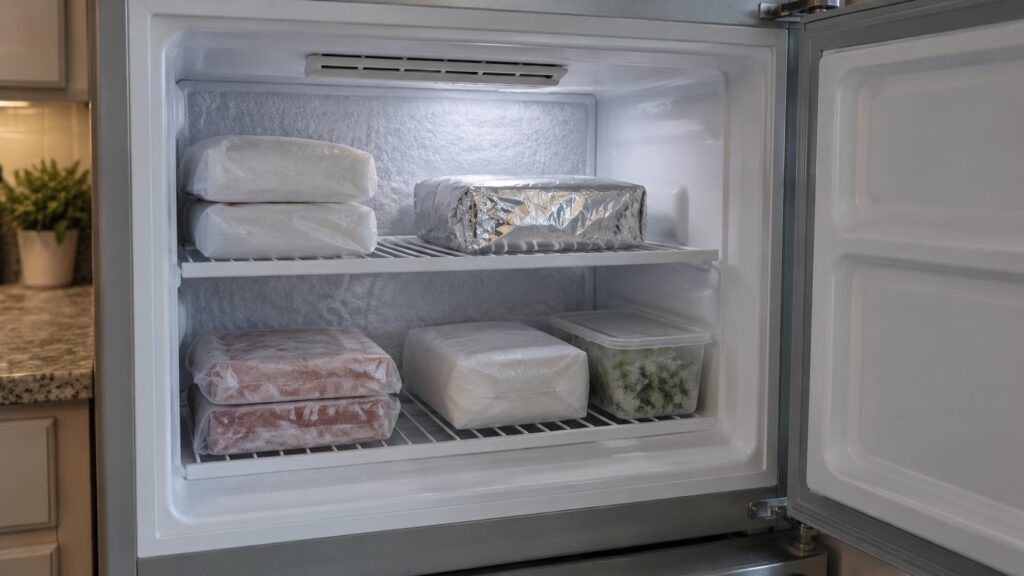
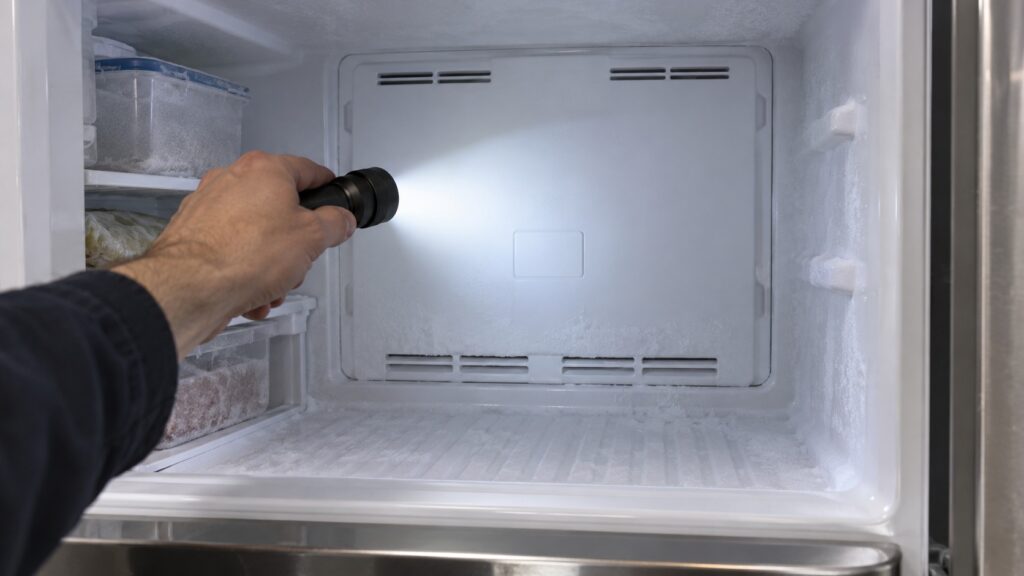
Ice can build up for reasons that have nothing to do with the heater. Our frost page lists these causes in order: moist air from frequent or long door openings, unwrapped food, a warped gasket, followed by a failed defrost control board on No-Frost models. Start with the simple ones. Close the door fully, check that nothing blocks the gasket, cover the food and look at the airflow vents inside the freezer. If the ice is a solid sheet on the back wall, or if it keeps returning within days after you clear it, the defrost system is the next suspect.
The water has to go somewhere. A defrost drain that clogs makes the meltwater back up and freeze, which looks like a defrost fault but is a drain fault. If you see ice on the floor of the freezer or water under the crisper drawers, read our page on refrigerator condensation buildup and the refrigerator running constantly page, since a coil that never clears also keeps the compressor running.
What if ice builds up on a new installation?
This is the question behind many searches. A refrigerator that has just been installed or moved will often see more frost for a while, for ordinary reasons: the doors are opened often, warm food goes in all at once and the humid air of a kitchen is entering the cabinet. Check that the refrigerator is level, that the doors close fully and that the gaskets are seated against the cabinet without a gap. If the frost keeps growing after a week of normal use, do not assume the new refrigerator is faulty: check the same simple causes first, and then book a visit. Our Electrolux refrigerator installation guide covers the water line and the first start, which are the other things that change when a refrigerator is new.
What can you safely do at home?
You can safely reduce the moisture, check the seal and clear the area. Keep the door shut, wrap food, do not load a lot of warm food at once, and keep the vents free. If the freezer is badly iced, a full defrost with the power off, the doors open and towels on the floor is the safe way to start again, as in our Electrolux freezer maintenance guide. Never use a heat gun or a sharp tool to chip at ice, because you can damage the lining or the cooling lines. If the ice returns after a clean defrost, the system is not clearing the coil on its own.
When should you call a technician?
Call when frost or ice returns within days after a clean defrost, when the freezer is warm while the compressor runs, or when food is softening. The defrost heater, the sensor and the control board are all behind panels and carry household voltage, so testing them is a technician’s job. Our Electrolux refrigerator repair service can pinpoint which part has failed. You can also read Electrolux freezer not freezing if the temperature is already off.