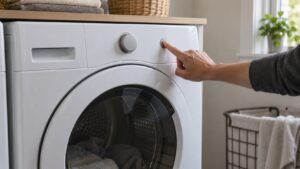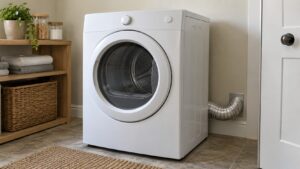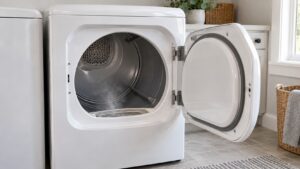
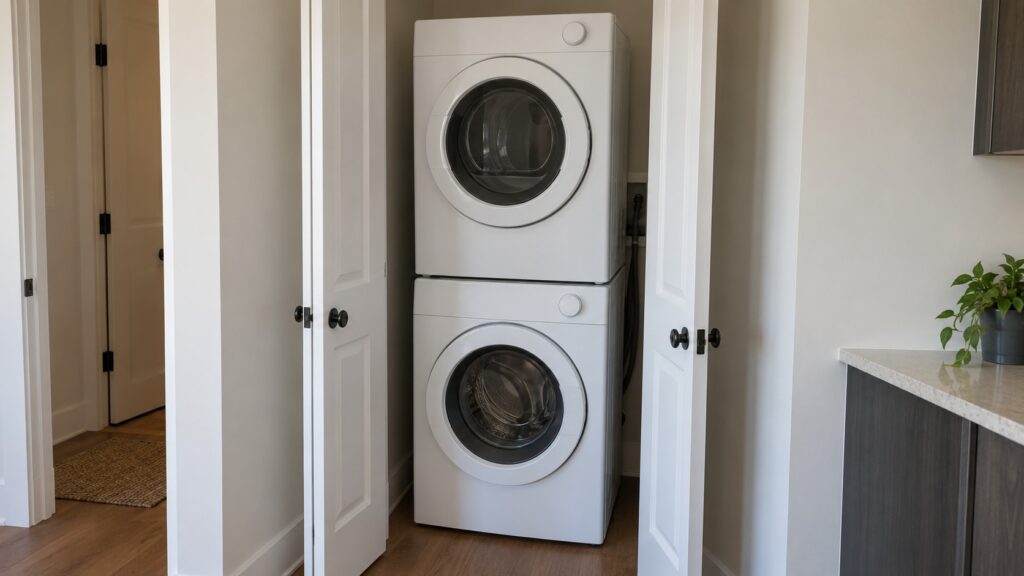
An Electrolux ventless dryer, such as the 24-inch ELFE4222AW, dries clothes in a closed loop instead of blowing hot, damp air outdoors. A heater warms the air, the air tumbles through the wet clothes and picks up moisture, and then it passes a heat exchanger where it is cooled enough for the moisture to condense into liquid water. That water is drained or collected, and the now-dry air goes back to the heater to start again. Because nothing leaves the cabinet as hot air, there is no exterior duct, which is why this design fits closets, apartments and any room where a vent cannot go.
How does a condensation dryer dry clothes without a vent?
Think of a cold glass on a warm day. Water collects on its outside because warm, humid air touching a cool surface gives up its moisture. A condensation dryer does the same thing on purpose, many times over. The drum air is heated by an element and pulled through the clothes, where it becomes hot and damp. It then flows through a heat exchanger, a set of fins or channels cooled by room air, and the moisture condenses on the cool surfaces and runs off as water. The air, now cooler and drier, returns to the heater.
The key difference from a vented dryer is where the moist air goes. A vented dryer exhausts it outdoors and pulls in fresh air continually. A ventless model recirculates the same air, so the dryer’s job is to take the water out of that air rather than push it away. It is a quieter and more contained process, and the price of that containment is time.
Where does the water go in an Electrolux ventless dryer?
The condensed water has to leave the machine. Depending on the model, it is pumped to a drain hose that you route to a sink or standpipe, or it collects in a removable tank that you empty after a cycle. Your manual shows which arrangement your dryer uses, and it is worth confirming before you set the machine up, since a drain hose needs a place to run and a tank needs a habit. A full tank or a kinked drain hose stops the cycle or leaves clothes damp, because the dryer cannot keep pulling water from the air with nowhere to put it.
Never let the hose rise above the pump’s reach or sag so that it holds water. A hose with a low loop retains water that can sour and smell, and a hose that is pinched behind the dryer is a common cause of a cycle that ends with damp laundry.
Why does a ventless dryer take longer, and is that normal?
Yes, within limits. A condensation dryer works at lower air flow and lower temperature than a vented one, because the heat exchanger has to cool the air and the loop has to stay balanced. Expect longer cycles than a vented dryer of similar size, particularly for towels and heavy cotton. The Gentle Dry Advanced program listed on the ELFE4222AW is a lower-heat program for delicate fabrics, so it will be longer still, by design.
Three things change the length of a cycle more than any fault. The first is the load: a 4.0 cubic foot drum is compact, and an overfilled drum dries poorly because air cannot move through the clothes. The second is the spin speed of your washer, since a load that arrives wetter takes longer. A washer with a high spin speed sends clothes in drier, and the matching ELFW4222AW compact washer is sized for the same load. The third is the room: a very cold or very hot room reduces how well the heat exchanger can cool the air. Our guide to an Electrolux dryer that takes too long covers the checks for a cycle that is longer than it should be.
What upkeep does a ventless dryer need?
- Clean the lint filter after every load. This matters more here than on a vented dryer, because lint that gets past a clogged filter ends up in the heat exchanger.
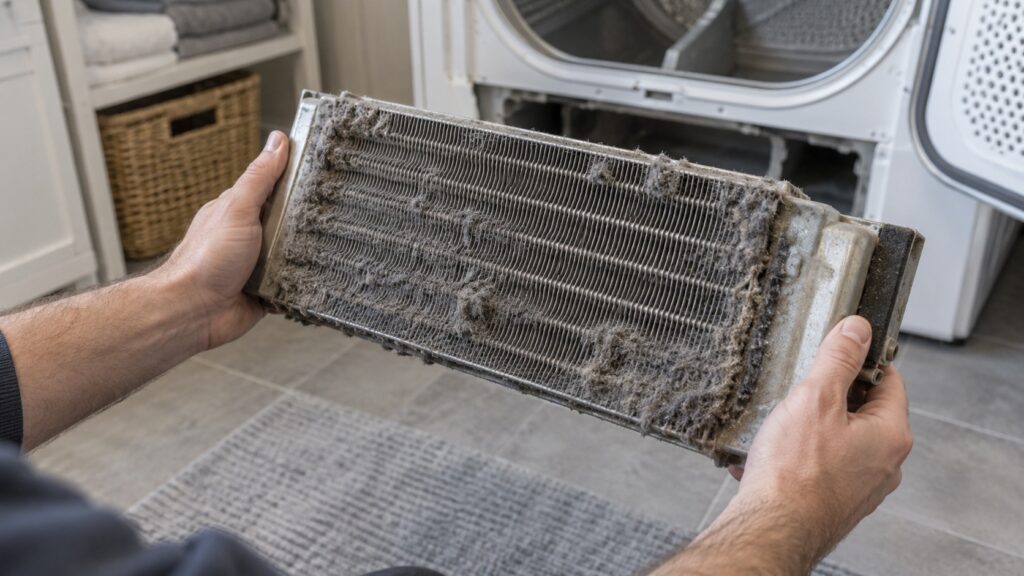
- Clean the heat exchanger on schedule. A film of lint on the exchanger insulates it and blocks airflow, and the dryer slows down and runs hot. Your manual shows how to reach it and how often; follow it exactly, and do not use sharp tools on the fins.
- Empty the water tank or check the drain. If your model has a tank, empty it every cycle or two, and if it has a hose, check it for kinks.
- Leave room for air around the cabinet. The exchanger cools using room air, so do not wall the dryer in or stack things against its intake.
- Wipe the door seal and the sensor area. Fabric softener residue can coat sensors and make the dryer misjudge dryness.
The sensing side of an Electrolux dryer is explained in our guide to how Predictive Dry works, and the steps for a vented model’s duct are in our dryer vent cleaning guide, which does not apply to a ventless machine.
Which Electrolux dryer codes should a ventless owner know?
The dryer code list on our site is common to the line. E1 and E5 are thermistor faults and belong to a technician, E2 means the high-limit thermostat has tripped from excess heat, E 4 is a failed humidity sensor, E 42 means the door is open and clears when it is closed, and H2 and H4 describe the electrical supply and the wiring at installation. EF1 is a ventilation warning written for vented models; on a ventless one the equivalent trouble comes from a clogged filter or heat exchanger, so check the manual before assuming your model shows it. Our Electrolux dryer error codes guide explains each code, and the page for E 42 covers the door code.
Is a ventless dryer the right choice?
It is the right choice when you cannot vent, because there is nothing else that works. It is also easy to install, since it needs only power and a drain. The trade-offs are longer cycles, smaller drums and a little more routine care. If you can vent, a vented machine such as those in our ELFE7437AT and ELFG7637AT comparison dries faster with fewer chores. When a ventless dryer needs attention, Electrolux dryer repair can help, and we are an independent service that will tell you if a fix is not worth doing.