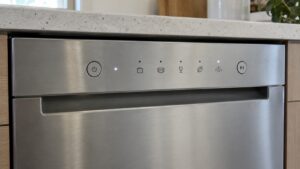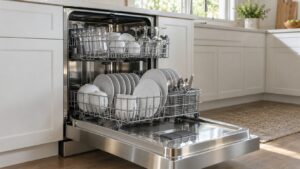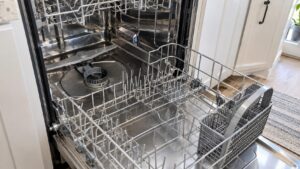
When you weigh an Electrolux dishwasher repair or replace decision, repair it when the fault is a small, common part on an otherwise sound machine, such as a clogged filter, a drain hose, a door latch, an inlet valve or a gasket. You should think hard about replacing it when a major component fails on a unit near the end of its service life, or when the control board and a second fault show up together. The fault, the part and the condition of the whole dishwasher decide it, not the age alone.
How do you decide whether to repair an Electrolux dishwasher?
Ask three questions in order. First, what exactly has failed? A dishwasher that stopped draining because of a blocked filter is a different problem from one that shows a memory fault on the control board. Second, how does the rest of the machine look: does it still wash well, is the tub clean, do the racks and door seal hold up? Third, is this the first fault or the latest of several? Our Electrolux dishwasher repair cost guide lays out the same scale in words: clearing a drain restriction, a door latch, an inlet valve or a gasket sits at the low end, a drain pump, wash pump or spray-arm assembly in the middle, and a control or user-interface board at the higher end. A common inexpensive part on a sound dishwasher is an easy call to repair.
Which Electrolux dishwasher codes point to a small repair?
Several of the site’s i-codes lead to owner-level checks and small parts. The page for i10 says the dishwasher did not sense enough incoming water, and the parts it lists are the supply valve, the inlet hose, its screen and the knockout plug. The page for i20 says water stayed in the machine past the drain window, usually a blocked filter or hose, and it lists the knockout plug, drain hose, glass trap, filter and sump. The page for i40 describes soil built up in the filter and sump area. None of these is a reason to replace a dishwasher; they are reasons to clean, check and, if needed, replace a small part. Our dishwasher maintenance guide shows the filter routine that prevents most of them.
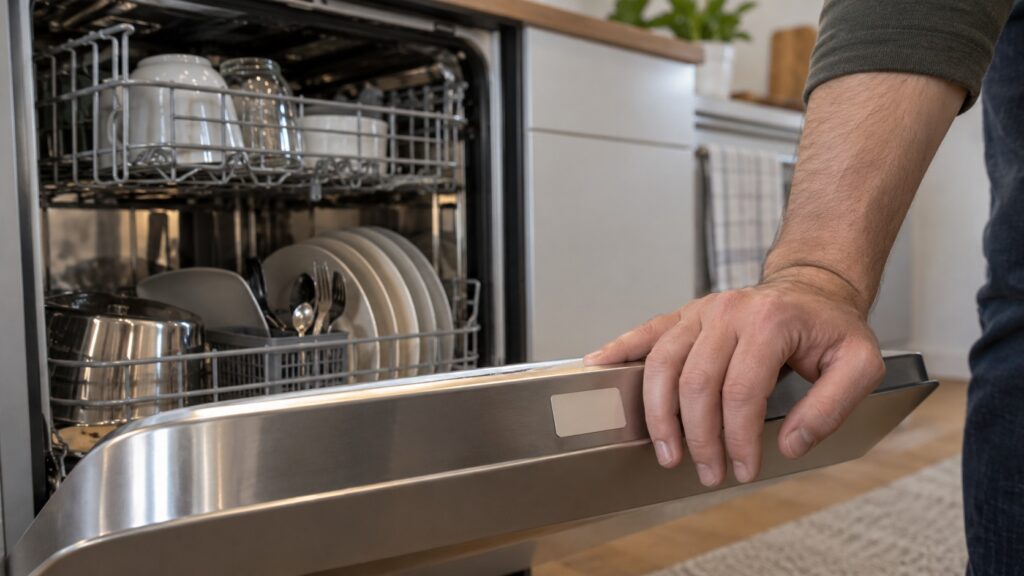
Which codes make you think harder?
A few code pages point at parts that cost more or need a technician. On our site, i50 refers to the wash-circulation pump not running correctly, i60 to water that is too hot or a faulty temperature sensor, i70 to the sump temperature sensor, i80 to a memory communication problem on the control board, and i90 to a control-board configuration problem that can also show as i91 to i99. The i80 and i90 pages list the control board and user-interface board among the parts, and those are the repairs that sit at the higher end of our cost scale. They are still diagnosable: a technician reads the stored code, confirms the cause and quotes the real fix before anything is replaced. The page for i30 deserves a separate mention: it says water was detected in the base pan and the flood switch tripped, and its parts list includes the door seal, spray arm, filter overflow and the flood switch. A dishwasher that has leaked into its base should be switched off at the breaker, with you standing on a dry floor, until someone has looked at it. Our i30 guide covers that code in depth.
When does replacement make more sense?
Replacement starts to win when several of these are true at once: the dishwasher is near the end of its service life, the fault is in a major component, the machine already has another fault or a history of repeat visits, and the tub, racks or door seal are in poor shape. We do not give an age cutoff, because the site has none for dishwashers and condition matters more than a number. Think of it as stacking: one inexpensive repair on a sound machine is fine, while a major component on a tired machine is worth thinking through against a new one. The same logic applies if you are remodeling and the dishwasher will be replaced anyway; a repair that only needs to last a few months is a different decision. If you are comparing a new unit, our EIDW6000 series buying guide explains one current line, and our dishwasher installation guide shows what a replacement involves.
What should you do before you decide?
Do the owner-level checks first, because they are free and they change the picture. Rinse the filter and clear the spray arm jets, check the drain hose for a kink, make sure the door latches, and look at the display for a code. Write down the code, what the dishwasher was doing when it appeared, and whether it returns after a restart. Find the model and serial number on the label at the edge of the door or inside the tub (your owner’s manual shows the spot), because a technician matches parts from them. Do not open the base, the kick plate or the control panel; that is a technician’s job, and it is where water and mains power are close together. You can read about Electrolux dishwasher repair before you book.