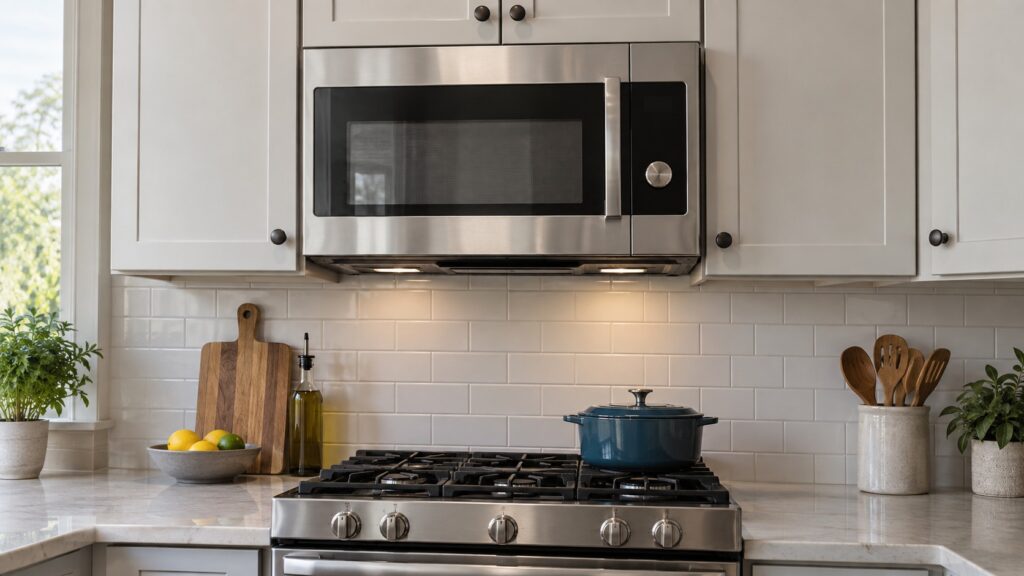
Electrolux over-the-range microwave installation takes a wall mounting plate screwed into studs, a top cabinet bolt-down, a vent connection chosen for your kitchen, and a grounded 120-volt outlet, and it is a two-person job because the microwave is heavy and must be held while it is fastened. Our site lists 30-inch over-the-range models such as the EI30SM55JS, a 2.0 cubic foot 1000-watt microwave with 3-speed 350 CFM venting, and the E30MH65QPS ICON, a 1.8 cubic foot model with convection and 400 CFM venting. This guide walks through the sequence so each step is checked before the next one hides it.
What do I need before I start?
Gather the paper template and installation manual that came with the microwave, a stud finder, a level, a drill and the right bits, a helper, and a clear space on the range to rest the microwave. Confirm the opening: the cabinet above should be the width of the microwave and the template tells you how high the bottom of the microwave must sit above the cooking surface. That height is a safety clearance, not a style choice, so measure from the cooktop surface, not from the oven door. Turn off the breaker for the outlet that will power the microwave, and make sure the outlet is grounded. If the outlet is not inside the cabinet space, plan how the cord will reach it without being pinched.
Check the cabinet above before you buy or lift anything. It should be solid, firmly fixed to the wall, and deep enough to take the bolts. A cabinet that wobbles, or one with a thin bottom panel, needs reinforcing first. Also look inside the cabinet space for the outlet and any existing duct, so the route is decided before the microwave comes out of the box.
How do I mark and mount the wall plate?
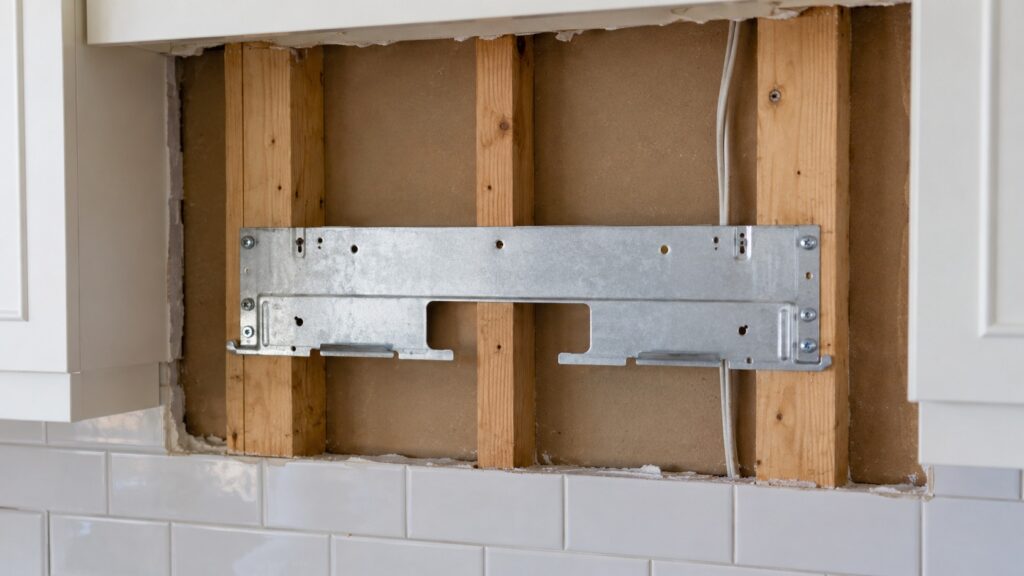
Tape the template to the wall, centered on the range and aligned with the cabinet edges. Mark the stud locations; most over-the-range microwaves rely on at least one stud to carry the weight, so a toggle bolt in bare drywall alone is not enough. Use the template to mark the holes in the wall plate and the holes in the cabinet bottom, drill the cabinet holes, and fix the wall plate to the studs with the supplied screws. Check that the plate is level before you tighten it, because a plate that tilts will make the microwave lean and the door close badly.
How should the microwave vent?
Over-the-range microwaves can vent two ways. Ducted venting sends the air outside, through the cabinet top or the back wall, and it is the better choice for a gas range or heavy frying. Recirculating venting passes air through a filter and returns it to the room, which suits a kitchen with no duct but does not remove heat or moisture. The EI30SM55JS lists 3-speed 350 CFM venting and the E30MH65QPS lists 400 CFM venting, which are airflow ratings; the numbers drop with every long run or elbow in the duct. Choose the route before you lift the microwave, since changing it later means taking it down. Our Electrolux microwave venting tips explain how to use the fan once it is in.
How do I lift and fasten the microwave?
This is where the helper matters. Keep the cord unplugged and out of the way until the end. Have one person hold the microwave while the other hooks the back of the unit onto the wall plate, then tilt it up to the cabinet. Align the bolt holes in the cabinet bottom with the slots in the top of the microwave, then drive the supplied bolts until the microwave sits snug against the cabinet and the wall. Do not over-tighten, since the cabinet bottom can crack. If the unit is a convection model like the E30MH65QPS, check that the weight rating of the cabinet and wall plate suits the heavier body. Never use the microwave’s own weight to test the bolts by letting go early.
How do I connect power and finish?
Route the cord to the outlet without kinks, and do not use an extension cord or power strip. A microwave should be on a dedicated circuit if your local code requires it. Switch the breaker on, plug in, and set the clock. Check the door opens and closes squarely, the turntable rolls freely, and the light and fan work at each speed. If the door does not close, the unit may be leaning from an unlevel plate. Run a cup of water for one minute and confirm it heats. Then check the vent damper opens when the fan runs, if ducted, and that the grease filters are in place.
What if something is wrong after installation?
A few faults appear straight after an install. If the microwave does not turn on, check the breaker and the outlet first. If it heats but the fan does not run, see the symptom page for a microwave vent fan not working. If it does not heat, read why an Electrolux microwave is not heating. For routine care of the filters and cavity, see the Electrolux microwave maintenance guide. If a microwave older than the kitchen it sits in keeps failing, our microwave repair or replace guide helps you weigh the choice. When you want a second set of eyes on a new installation, Electrolux microwave repair can check it, and you can schedule a visit any time.