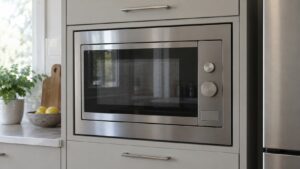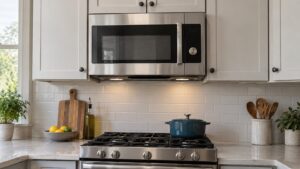
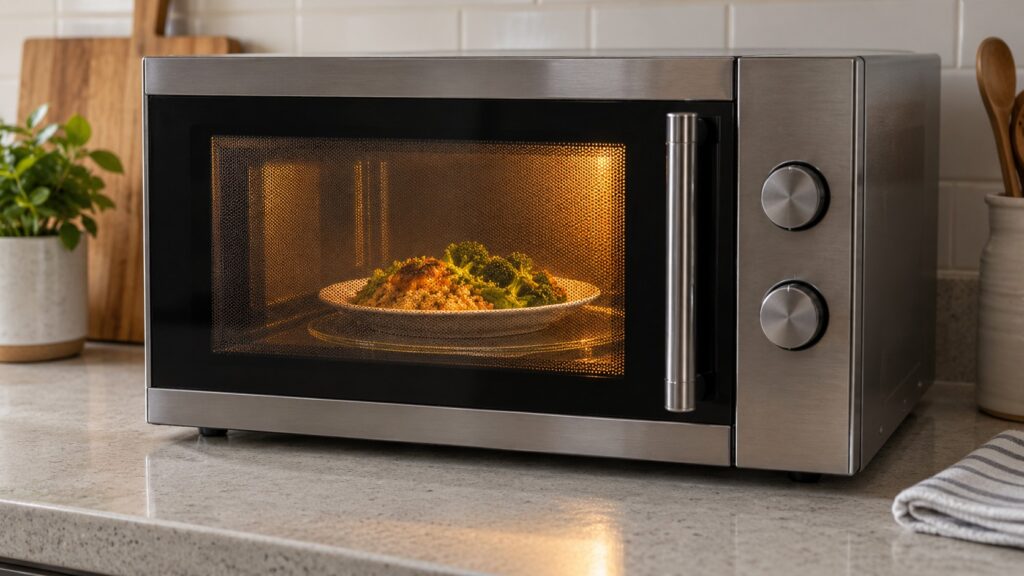
To understand how an Electrolux microwave works, start with one part: the magnetron, which generates microwave energy. That energy is guided into the metal-walled cooking cavity, where it heats the water in food, while a turntable moves the plate so the heating is more even. Door interlock switches must all register a closed door before the high-voltage circuit is allowed to run, and a fan keeps the electronics cool. Everything inside the cabinet that handles high voltage is technician-only.
How does a microwave heat food?
A microwave oven does not heat the air. The magnetron makes microwave energy, and that energy is guided from the magnetron through a metal channel called a waveguide into the cooking cavity. The cavity walls reflect it, and food absorbs it. Water in food is what absorbs it most readily, which is why a cup of water or a plate of leftovers warms quickly while a dry, empty dish does not. This is the general way microwave ovens work, and our Electrolux pages describe the same parts: the magnetron, the high-voltage diode and capacitor, the high-voltage transformer, the door interlock switches, the turntable motor and coupling, the cooling fan and the control board.
What does the turntable do?
Microwave energy does not fill a cavity evenly, so a plate left in one spot would heat unevenly. The glass turntable slowly rotates the plate through the energy so different parts of the food take turns. Our turntable guide explains that a tray that stops turning is usually a broken glass-tray coupling or support ring, or the turntable option switched off in the settings, and both are owner-level checks. Whether you can turn the turntable off, and how, depends on the model, so see your owner’s manual.
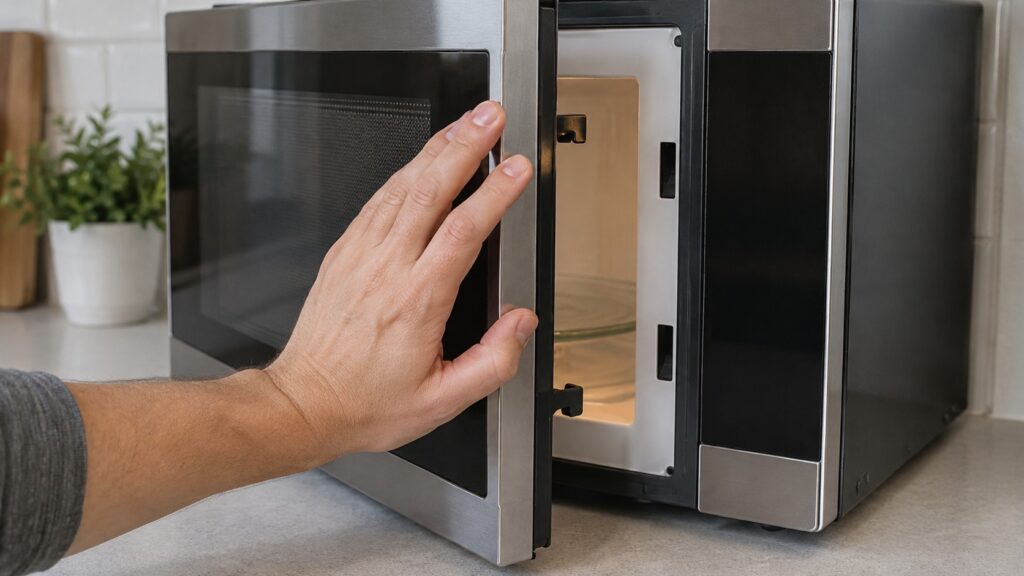
What do the door interlock switches do?
They are the safety system. Our microwave not heating guide says several door safety interlock switches must all register the door as fully closed before the high-voltage circuit is allowed to energize. If one has failed or gone out of alignment, the microwave may run its fan and turntable but never produce microwave energy, as a safety measure. That is why a microwave that runs with a lit display and spinning plate but heats nothing may have a door-switch problem, a blown high-voltage diode or capacitor, or a failing magnetron. The door seal and latch matter for the same reason: a door that seems to close but does not seat fully can affect the switches. If the door will not close or latch normally, do not force it; see our page on a microwave door that will not close.
What are Sensor Cooking and Convection Cooking?
Our Electrolux microwave page says these are the two named features the lineup is built around. Sensor Cooking, also called Sensor Cook or Auto Sensor Cooking on ICON models, adjusts time and power based on the steam the food releases. Convection Cooking is for browning and crisping beyond a standard reheat. The page also lists Multi-Stage Cooking, a Blue LED Display, Control Lockout and a Second Tier Rack on current models, and the combination wall-oven units add True Convection or Perfect Taste Convection to the oven cavity. In general terms, a convection feature adds a heating element and a fan to the cavity so the food can brown. Exactly what each feature does and which cooking buttons control it on your exact model is in your owner’s manual.
Why is the cooling fan important?
The magnetron produces heat, and the fan is what keeps it within safe limits. Our site says a microwave that shuts off early usually has a cooling fan that is not spinning freely, which lets the magnetron overheat and trip a safety thermostat. On over-the-range models the unit also doubles as a range hood, so a vent-fan complaint is often unrelated to the cooking function; our venting tips guide covers that side. Dust in the fan and vents is a good reason for the routine in our microwave maintenance guide.
Which parts are safe for you to touch, and which are not?
The only parts an owner should handle are the ones inside the cooking cavity and on the outside: the glass tray, its support ring and coupling, the interior walls and the door seal, all cleaned with the microwave unplugged and cool. The waveguide cover should be kept clean of grease and intact. Do not open the cabinet. Our site warns that the high-voltage capacitor can hold a lethal charge even after the unit is unplugged, so internal diagnosis and repair is technician-only. If you see sparking, stop the microwave and unplug it, then remove any metal or dishware with metallic trim once it has cooled; do not run the unit empty. If there are flames, keep the door closed, do not open it to look, switch the microwave off at the breaker if you can reach the panel safely, and call 911 if the fire does not go out. If sparking continues, or the interior paint is chipped, stop using it and book a visit.