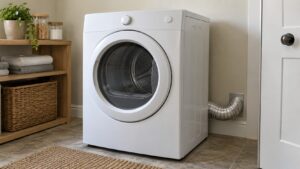
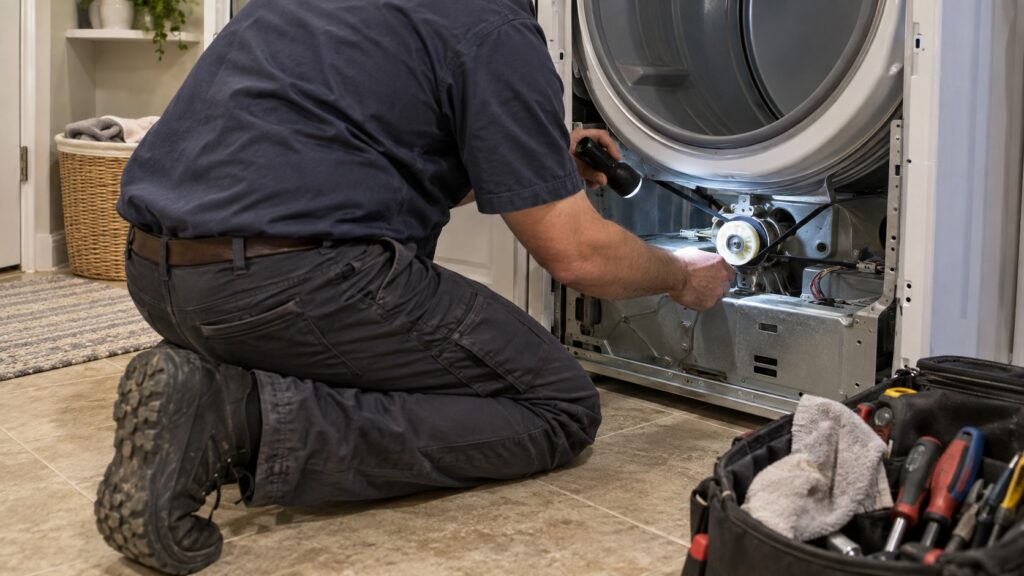
Repair an Electrolux dryer when it is under about eight years old and the fault is a single part — a heating element, a thermistor, a belt or a door switch. Lean toward replacing it once the drum support, the motor, or the control board itself is the failing part on a machine already past that age, because a second major repair tends to follow within a year or two on a dryer that old.
What decides whether an Electrolux dryer is worth repairing?
Two things carry most of the weight: the dryer’s age and which part actually failed. A five-year-old dryer with a bad thermal fuse or a worn belt is an easy repair call — those are inexpensive, well-understood fixes on a machine with plenty of working life left. A twelve-year-old dryer with the same fault is still often worth fixing, because the part itself is cheap; the calculation changes when the failing part is the motor, the drum support system, or the electronic control board, since those repairs cost more and tend to surface on dryers that are already showing their age in other ways.
Which Electrolux dryer faults are usually worth fixing outright?
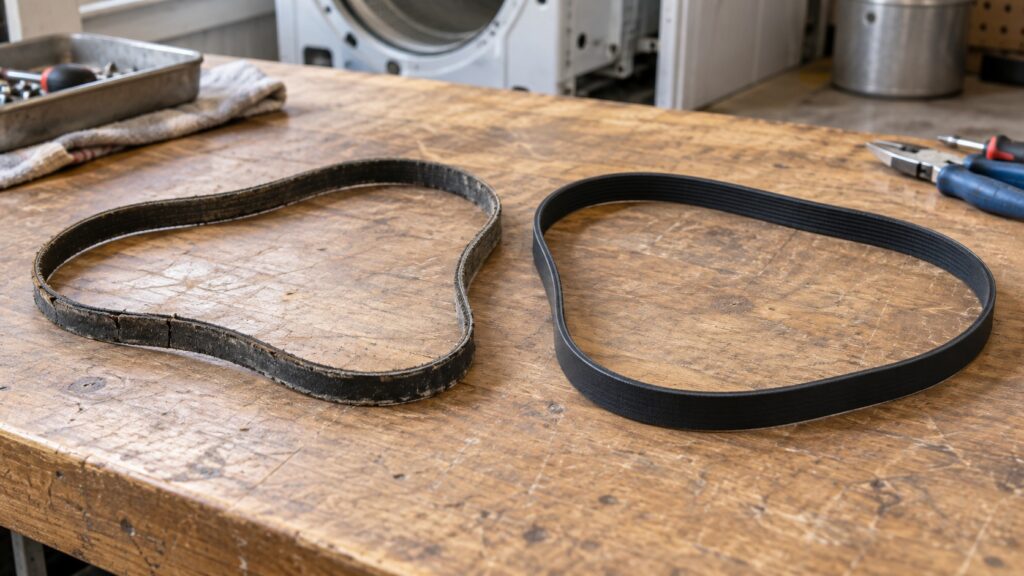
A heating element that has burned out, a thermistor reading incorrectly, a worn drive belt, a door switch that has failed electrically, or a tripped thermal fuse are all common, moderately priced repairs on this brand’s electric and gas dryers. None of these point at a dryer that is wearing out generally — they are wear parts that fail on their own schedule regardless of the machine’s age, and replacing one restores the dryer fully rather than buying time until the next part goes.
Which faults tend to tip the decision toward replacement?
A failed motor, worn drum rollers or bearings that have let the drum start dragging on its support, or a control board that has failed outright all cost more to fix and often show up together with other early wear on an older machine. On a dryer already past roughly eight years, a motor or control-board failure is a reasonable point to at least price a comparable new unit against the repair estimate before committing, rather than assuming the repair is automatically the cheaper path.
Does a dryer’s repair history matter as much as its age?
Yes, and it is easy to underweight. A dryer that needed one unrelated repair three years ago and is otherwise reliable is a different case from one that has needed two separate repairs in the past year. A pattern of repeat calls, even for different parts, usually means several components are aging out around the same time — fixing the part in front of you does not reset that clock, and the next part is often close behind.
How much does an Electrolux dryer repair typically cost compared to a new one?
Costs vary by part and by region, and we do not quote a flat number here, but a useful rule of thumb is to treat any single repair estimate that approaches a large share of what a comparable new dryer costs as a signal to compare the two seriously rather than repair on reflex. A technician who gives you a written estimate before starting work is giving you exactly the number needed to make that comparison honestly.
What should a written repair estimate actually include?
A useful estimate breaks out the diagnosed part, the parts cost, and the labor separately rather than handing over one lump figure, because a lump number hides exactly the information needed for a repair-or-replace comparison. It should also state whether the price covers only the diagnosed fault or anticipates a related part failing soon after — a drum-support repair, for instance, sometimes surfaces a worn roller that was not part of the original complaint. Asking for that breakdown before any work starts is the single easiest way to turn “should I fix this” from a guess into an informed decision.
What should you check before deciding either way?
Confirm the exact fault first — a full diagnostic rather than a guess — since “won’t heat” and “takes too long” and “won’t turn” each point at different parts with very different repair costs. Then weigh that specific repair against the dryer’s age and its repair history together, not the age alone. A young dryer with a cheap part is an easy repair; an old dryer with a second major failure in a year is a legitimate replace decision, and most cases in between come down to comparing a real estimate against a real new-unit price rather than a rule of thumb alone.
Framed as a single question, an Electrolux dryer repair or replace decision usually comes down to three numbers: the machine’s age, the cost of the specific repair, and how many separate repairs it has needed recently. When two of those three numbers point the same direction — old and expensive, or old and repeat-failing — that is a much stronger signal than any one of them alone. When only one number looks bad, such as a moderately priced repair on an otherwise reliable ten-year-old dryer, repairing it is usually still the more reasonable call.
Does a dryer’s usage level change when replacement makes sense?
Yes, and it is worth weighing separately from age alone. A dryer run through several loads a day for a large household accumulates wear faster than the same model running one or two loads a week, so two units of identical age can be at genuinely different points in their working life. A heavily used dryer that starts needing repairs earlier than the age-based guidance above suggests is not necessarily defective — it has simply logged more cycles in the same calendar span, and that usage history is worth factoring in alongside the calendar age when a repair estimate comes in higher than expected.
Does gas vs. electric change the repair-or-replace math?
Not fundamentally. Both configurations share the same wear parts — belts, rollers, door switches, thermal fuses — and both can develop the same motor or control-board failures with age. Gas dryers add a burner assembly and igniter to the list of parts that can fail, which is one more category of fault to diagnose correctly, but it does not change the underlying repair-or-replace logic: a single-part fault on a younger unit is usually worth fixing, and a major-component failure stacked on an older unit with a repair history is usually worth comparing against a new dryer’s price.
One check is worth doing before pricing any repair at all, regardless of age or fault: a crushed, clogged or overly long exhaust vent run can make a perfectly healthy dryer run hot, shut off early, or take two cycles to dry a load that should take one — symptoms that look exactly like a failing heating element or a tired motor. Clearing or shortening the vent run costs nothing but a few minutes, and it rules out the cheapest possible explanation before a technician is called out to diagnose a part that was never actually the problem.
For the fault itself, see our dryer not heating guide, dryer not turning guide, or dryer takes too long guide to identify which part is actually failing before pricing anything. Our dryer error codes guide can also narrow the fault from the code on the display. When you have a specific fault and want an honest number for both options, schedule Electrolux dryer repair or book a diagnostic visit.