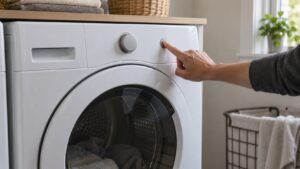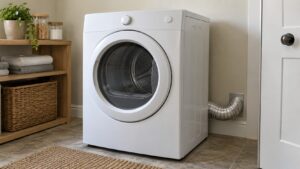
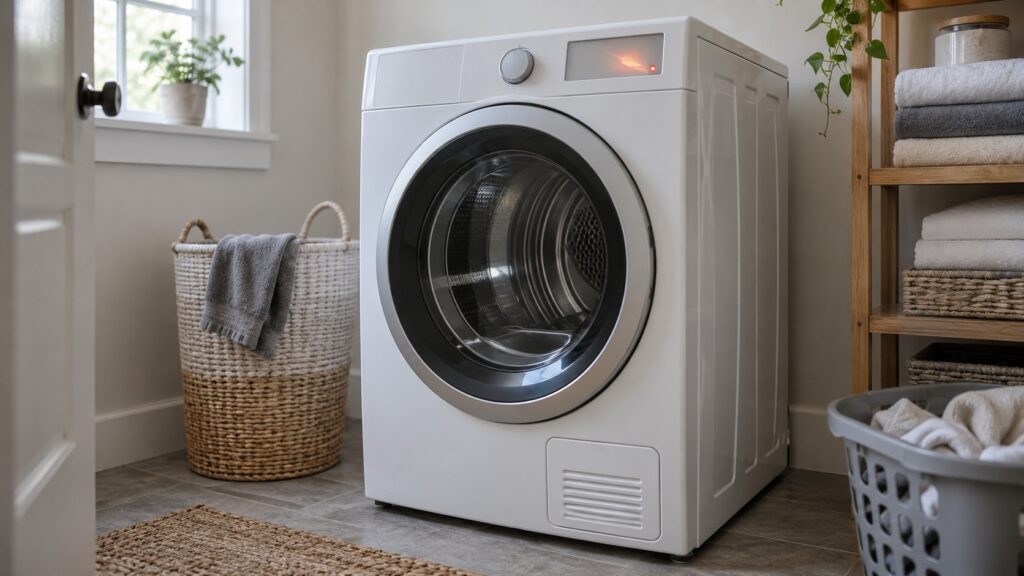
The electrolux dryer error codes that reach us most often are E1, E2, E5 and EF1, and three of those four are about one thing: how hot the air gets and how freely it moves. E1 and E5 are thermistors reporting an impossible temperature, E2 is the safety thermostat that has already tripped, and EF1 is a warning that the exhaust path is blocked. Read together they tell a single story, which is why we treat them as a family rather than as four separate faults.
Which Electrolux dryer error codes matter most?
Codes are not equally urgent. E 42 means the door is open and clears itself. EF1 is a warning you can act on in twenty minutes with a vacuum. E1, E2 and E5 involve parts inside the cabinet and belong to a technician. H2 and H4 are not really dryer faults at all — they describe the electrical supply feeding it, and one of them is a message for your utility rather than for us.
Sorting them that way saves money before anyone opens a panel. A household that sees EF1 and calls for a heating element has bought a part it did not need; a household that sees E2 and keeps running the machine is trusting a safety device that has already done its job once.
What do E1, E2 and E5 mean on an Electrolux dryer?
A dryer measures its own air temperature with thermistors — resistors whose resistance falls as they warm. The control reads that resistance continuously and adjusts the heat. When a reading falls outside anything physically possible, the control stops and reports it.
E1 is the exhaust-air thermistor reading open or out of range — in practice, above roughly 50,000 ohms when it is faulty. The sensor itself fails, or the wiring to it goes loose or corroded. E5 is the same class of fault at the outlet thermistor: resistance very high or open, sensor or connection. E2 is different in kind. It means the high-limit thermostat, a mechanical safety device, has opened because the internal temperature exceeded its threshold. Restricted airflow is the usual reason. A thermistor reading far too low can present the same way, which is why a technician tests both before deciding.
The practical consequence of E2 is worth stating plainly: the dryer got hotter than it is allowed to get. That device is the last line between a lint-filled cabinet and a fire, and a dryer that trips it repeatedly should not keep running while you think about it.
What does EF1 mean, and why does airflow come first?
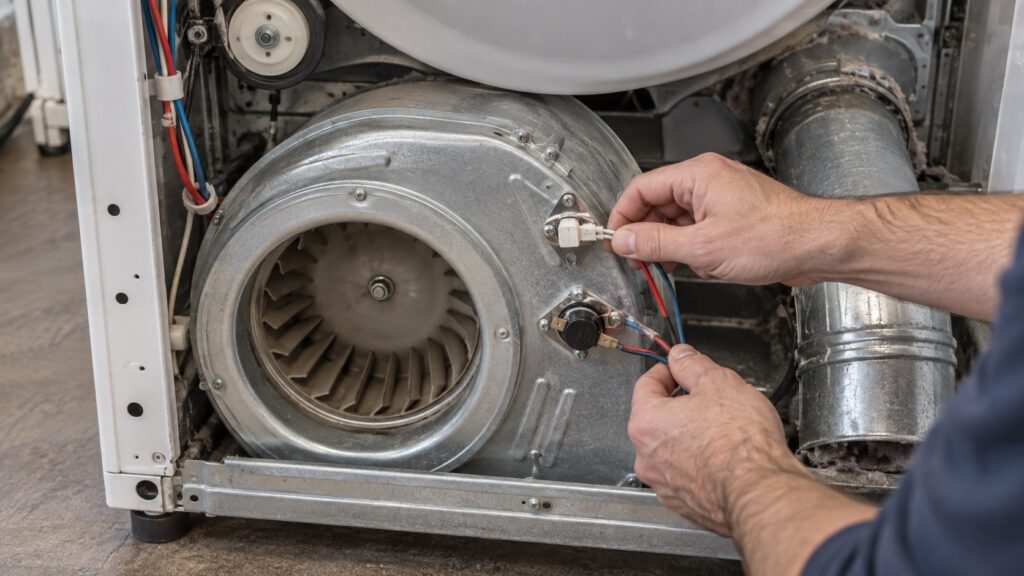
EF1 is a ventilation-blockage warning, and the causes the code page lists are a clogged lint filter, a blocked exhaust duct and an obstructed outside vent hood — a bird nest, debris, or a flap that has stuck shut. Notice that all three are outside the sealed part of the machine, which makes EF1 the one code on this list an owner can usually resolve.
Airflow also sits underneath the heat codes. A restricted duct raises the internal temperature until the high-limit thermostat trips, so an EF1 that goes unattended becomes an E2 eventually. When we arrive for a heat fault, the vent is the first thing we look at, and our dryer vent cleaning guide has the routine we recommend twice a year. If the machine is running but clothes stay damp, the symptom-first path in why an Electrolux dryer takes too long may fit better than any code.
What about E3, E 4 and E 42?
These three have nothing to do with heat. E3 is a control-board communication error: the boards inside the dryer are not exchanging signals correctly. It behaves like the cooktop communication fault in our Electrolux cooktop E8 guide — a wiring, connector or board problem rather than a component that has burned out.
E 4 is the humidity sensor. On an Electrolux dryer the moisture sensor strips inside the drum decide when an automatic cycle ends, so a failed sensor produces cycles that stop far too early or run far too long. Before replacing anything, wipe those strips: fabric softener leaves a film on them that fakes dry laundry, and that film accounts for a good share of the sensor complaints we see.
E 42 means the door is open. Usually it is. When it is not, the door switch or its wiring is at fault, and the dryer is simply believing what it is told.
What do H2 and H4 mean?
H2, sometimes shown as B2, is a power-supply issue — the code page words it as “Contact Electric Company”, because it describes an external utility condition rather than anything inside the cabinet. An electric dryer runs on two legs of 240-volt service, and losing one leg leaves the drum turning with no heat at all.
H4, also shown as B4, means incorrect wiring at installation. It appears on new installs and after a move, when the cord, the receptacle or the terminal block has been connected wrong. Neither code is a part failure, and neither should be answered by ordering a heating element.
What can you check before calling?
- Clean the lint filter, and wash it in warm water if it feels waxy from dryer sheets.
- Pull the dryer out and check the duct behind it for kinks, crushed sections and packed lint.
- Go outside, open the vent hood and confirm the flap moves freely with the dryer running.
- Wipe the moisture sensor strips inside the drum with a cloth.
- Run a timed cycle rather than an automatic one, and note whether the code still appears.
- Write down the exact code, when it shows, and the model and serial number.
Stop there. The thermistors, the high-limit thermostat and the control boards live behind panels that also carry line voltage, and on a gas model the burner assembly is in the same space. Opening the cabinet is where this job stops being maintenance.
When is an Electrolux dryer code a job for a technician?
Call when E1, E2, E5 or E3 appears, when EF1 returns after the vent is genuinely clear, when the dryer heats intermittently, or when a code follows work on your electrical panel. Our guide to an Electrolux dryer that will not heat covers the symptom side of the same parts.
We are an independent repair company and not a factory service arm. Pricing starts from a diagnostic visit and we confirm the estimate before any work begins. Electrolux dryer repair covers thermistors, thermostats, elements, igniters, sensors and controls on both electric and gas machines. You can schedule a visit online or call (844) 414-1609.