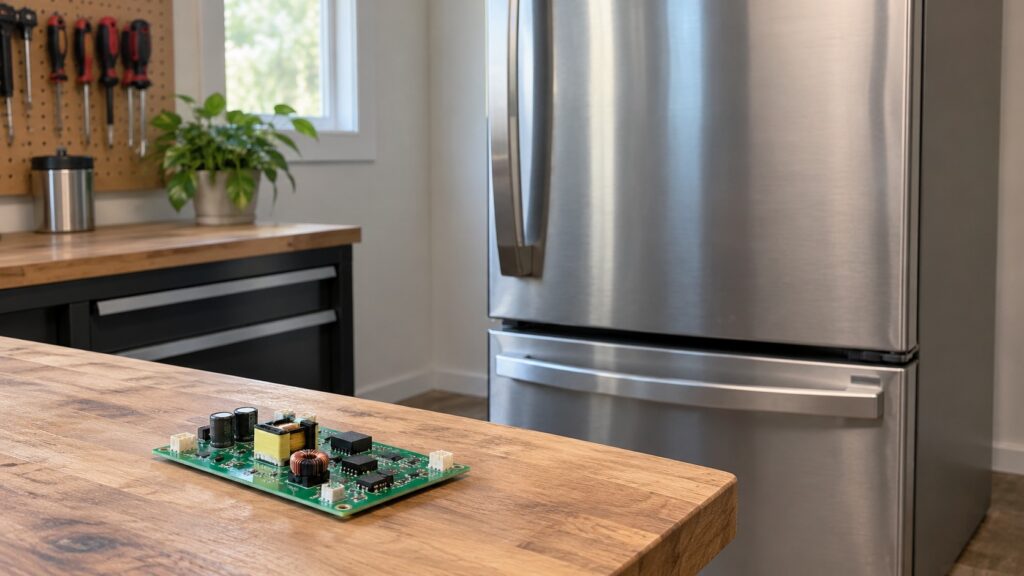
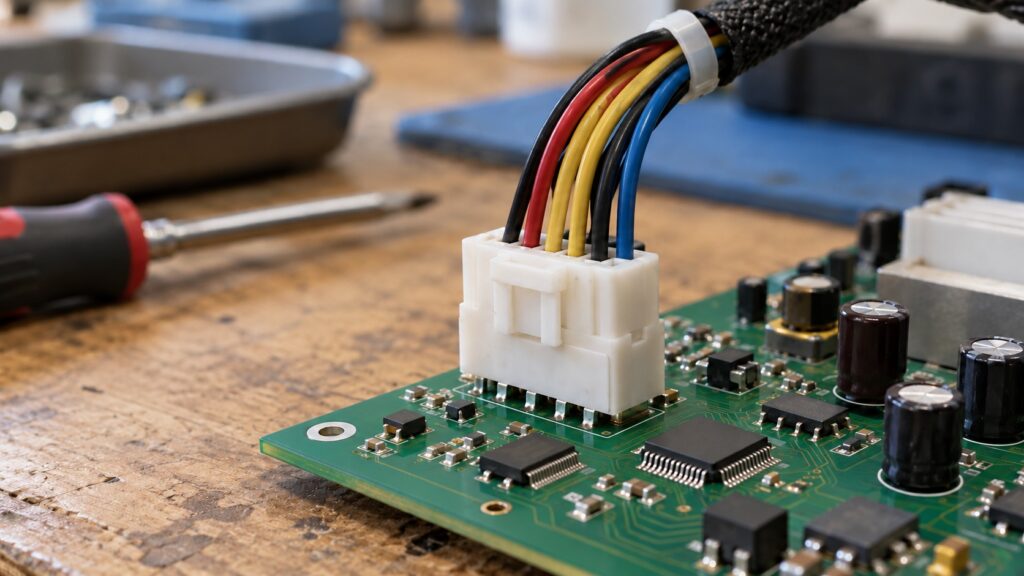
An Electrolux refrigerator control board is worth repairing or replacing when a technician has confirmed that the board itself has failed, and when the refrigerator is young and sound enough to justify it. The board is also one of the most over-blamed parts: fans, sensors, relays and the defrost circuit produce symptoms that look like a bad board. The right order is to diagnose first, then decide using the age and condition of the whole refrigerator, never the board alone.
What does the control board do in an Electrolux refrigerator?
The control board is the part that reads the temperature sensors, runs the fans and the defrost circuit, and responds to the settings on the display. Because it sits in the middle of all of that, almost any cooling complaint can be blamed on it. Our pages for Electrolux refrigerators list the board by name only in one place: a faulty defrost control board is one of the reasons a refrigerator can run nonstop. Everything else on our symptom pages points to simpler parts first: dirty condenser coils, a failed evaporator fan motor, a bad start relay, a blocked air damper or vent, and a faulty temperature sensor.
How do you know it is the board and not a cheaper part?
You cannot tell from the outside, and neither can a part counter. That is why our symptom pages send you through the cheap checks first. For a refrigerator that is not cooling, clean the condenser coils if you can reach them without removing panels, clear any blocked interior vents, confirm the controls are set correctly and power cycle the unit, then give it several hours to recover before judging. Our guide to an Electrolux refrigerator not cooling goes through the order. For a compressor that runs all the time, remember that many modern variable-speed compressors run near-continuously by design, so it may be normal. Our page on an Electrolux refrigerator running constantly lists the gasket, the frosted coil and the board in that order. Our page on a temperature display error or alarm explains that an alarm often only means the door was open too long or the power was out, and that a persistent alarm points to a sensor or a cooling fault.
A technician checks the parts the board drives and the sensors that feed it before condemning the board. That is the diagnosis worth paying for.
When does it make sense to repair or replace the board?
When the refrigerator is otherwise sound. Our repair or replace guide says that a common part on a healthy refrigerator under roughly ten years old usually favors repair, and that the picture changes past roughly twelve to fifteen years, when problems begin to stack up, or when the failure is in the sealed system. A control board is not on the guide’s list of everyday parts such as gaskets, water filter housings, evaporator fan motors, defrost thermostats and ice maker modules, so treat it as a part whose value you weigh against the age of the whole unit. If the board is the only fault, the refrigerator is in its first decade and the cabinet, door seals and compressor are in good condition, a replacement board is a reasonable repair. If the refrigerator is old and also showing a second problem, such as a weak door seal or noise from the compressor, spending on a board is harder to justify. Read the full Electrolux refrigerator repair or replace guide before you decide.
Can a board be repaired, or only replaced?
That depends on the part and on the technician, and we cannot promise either. The right board is matched from the model and serial number, so have both ready. Where a repair is not worth doing, we say so plainly: we are an independent service, and the estimate is confirmed before any work begins. Ask the technician what the board does on your model and what else the fault could be, and ask what happens if the board is replaced and the symptom stays. A diagnosis that names the failed part, not a guess, is what turns the cost question into a real answer.
What should you do yourself, and what should you not?
You can do one hard reset by unplugging the refrigerator for two to five minutes, as our temperature display page describes, then restoring power, and you can clean the door gasket, clear blocked vents and make sure the doors close. Do not open the back or base panels, do not unplug connectors, and do not test anything with a meter; that is a technician’s job. If the refrigerator is warm, protect the food: according to the FDA, a closed refrigerator keeps food safe for about 4 hours without power, a full freezer for about 48 hours (24 hours if half full), and the safe limit is 40 degrees Fahrenheit. If water or burning smell appears near the plug or cord, switch off the breaker at the panel while standing on a dry floor, and never pull a plug from a wet outlet. Our Electrolux refrigerator maintenance guide covers the routine care that avoids many repeat calls.