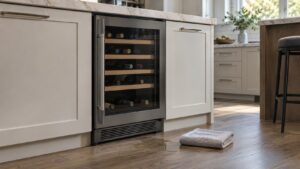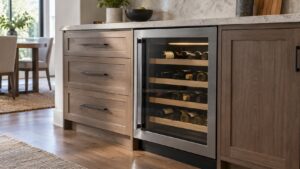
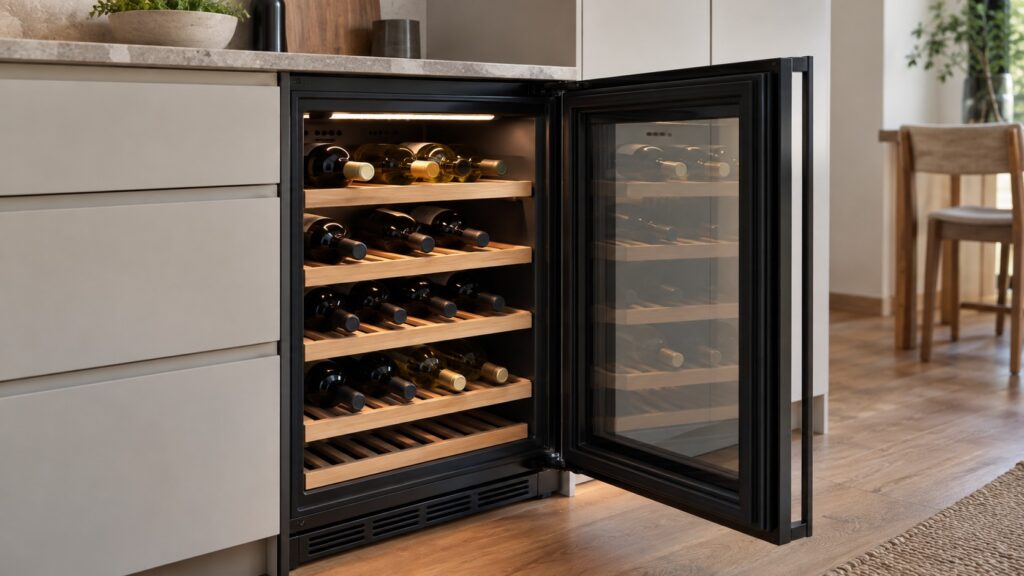
These Electrolux wine cooler storage tips come down to four habits: keeping bottles horizontal, not overcrowding the shelves, giving the unit a stable place away from heat and vibration, and resisting the urge to open the door often to check on things. None of these cost anything, and together they matter more to how well the wine actually keeps than fine-tuning the temperature setting by a degree or two. Most complaints about a wine cooler “not doing its job” trace back to one of these four habits rather than to the appliance itself.
Why do bottles need to stay horizontal in a wine cooler?
A horizontal bottle keeps wine in constant contact with the cork, which keeps the cork swollen and sealed against the bottle neck. A bottle stored upright for an extended period lets the cork dry out slowly, and a dried cork can shrink enough to let in air, which is exactly what a wine cooler is trying to prevent in the first place. Nearly every Electrolux wine refrigeration shelf is designed as a slotted or tiered rack specifically to hold bottles this way, so using the shelves as designed does most of the work automatically.
How full is too full when loading a wine cooler?
Leaving small gaps between bottles matters more than people expect, because a wine cooler cools with circulated air rather than direct contact, and a shelf packed edge to edge blocks that circulation. The bottles at the front and the back of an overloaded shelf can end up at noticeably different temperatures from each other, even though the display shows one steady number. A shelf loaded with visible gaps between bottles holds a far more even temperature across the whole rack.
Where in the kitchen should a wine cooler actually sit?
Direct sunlight and nearby heat sources — an oven, a range, a sunny window — work against the compressor constantly, forcing it to run longer to hold the set temperature. Vibration matters too, more than most people realize: a spot right next to a frequently slammed door or in a high-traffic walkway introduces small, constant vibration that can disturb the sediment in aging red wines over time. A quiet, stable, out-of-the-sun spot is worth prioritizing over a spot chosen purely for kitchen layout convenience.
Does opening the door often actually matter?
Yes, more than it does for a kitchen refrigerator. Wine coolers are tuned to hold a narrow temperature band, and every door opening lets in a burst of warmer room air that the unit then has to work to remove again. A kitchen refrigerator recovers from a quick door opening fast because it runs a wider temperature swing already; a wine cooler set to a tight, specific temperature takes longer to settle back down, so frequent short visits to “check on things” add up to more temperature drift than a couple of longer, deliberate visits would.
What cleaning habits keep a wine cooler running efficiently?
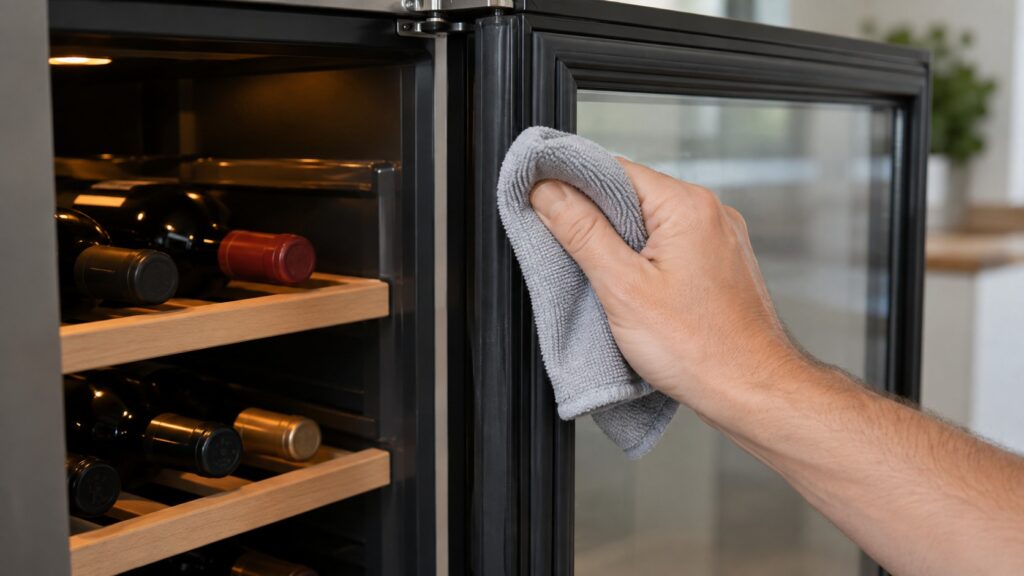
Wiping down the shelves periodically keeps spilled wine or dust from building up around the airflow paths, and checking the door seal for a snug, even close is worth doing every few months. A door seal that has picked up grime or lost its grip in one spot lets in warm air continuously, in a way that is easy to miss because nothing about it looks broken — it just slowly makes the compressor work harder for the same result.
Does humidity inside a wine cooler need any attention?
A wine cooler holds a slightly higher humidity than a kitchen refrigerator on purpose, since a cork that dries out too quickly is as much a problem as heat is. Most units manage this on their own through their sealed cabinet design, but a door that does not close fully, or one left open for long stretches while loading bottles, lets that humidity escape along with the cool air. If corks on long-stored bottles start looking unusually dry from the outside, checking the door seal and closing habits first is a more useful step than assuming the unit itself has a humidity fault.
A quick monthly check is enough for most households: run a hand along the closed door seal and feel for any spot where the rubber has flattened or where the door does not pull in snugly. Dust on the back or underside vents, where a unit’s model allows access, is worth clearing too, since a dusty vent restricts the same airflow that clean shelf loading is trying to protect.
Does the type of wine change how it should be stored?
Most dual-zone Electrolux wine coolers split the cabinet into two temperature bands specifically because reds and whites keep best at different temperatures, and loading a bottle into the wrong zone works against the appliance rather than with it. Sparkling wines in particular benefit from the cooler end of the range and from being disturbed as little as possible, since the pressure inside the bottle makes it more sensitive to temperature swings than a still wine is. If a unit has only one zone, setting it toward the middle of the recommended range for the collection actually stored, rather than the coldest setting available, usually serves the whole collection better than optimizing for one type of wine alone.
Keeping labels facing forward does more than make the cooler look tidy — it is the fastest way to spot how long a bottle has actually been sitting there without pulling every one out to check. A bottle meant to age for years and one meant to be opened next weekend look identical from the side, and a cooler that gets reorganized occasionally by date rather than left to fill up randomly is far easier to manage without accidentally opening something too early or forgetting something for too long.
Should a wine cooler ever be unplugged when it’s empty?
Generally no, even between deliveries or during a stretch with few bottles on hand. Cycling a compressor off and back on repeatedly puts more strain on it over time than leaving the unit running continuously at its set temperature, and an empty cooler left off for an extended stretch can develop condensation or a musty smell inside the cabinet that a running, humidity-controlled unit does not. If the cooler needs to sit empty for more than a few weeks — during a move, for instance — leaving the door slightly propped with the power off is a better combination than leaving it fully sealed and unplugged for that same stretch.
What if the wine cooler still isn’t holding temperature well after all this?
Give any habit change a few days before judging it, since a wine cooler’s internal temperature settles slowly rather than snapping to a new reading the moment a habit changes. If bottles are stored properly, the shelf isn’t overloaded, the unit sits away from heat, and the door seal looks fine, but the temperature still swings or the unit runs constantly after giving it time to settle, the issue has likely moved past a habits problem and into a mechanical one. Our wine cooler not cooling guide covers that next step, and our wine refrigeration maintenance guide covers the deeper cleaning and upkeep beyond these daily habits. If you’re deciding on a unit in the first place, our wine refrigeration buying guide is a useful next read. Schedule Electrolux wine refrigeration service or book a visit if the temperature problem persists.