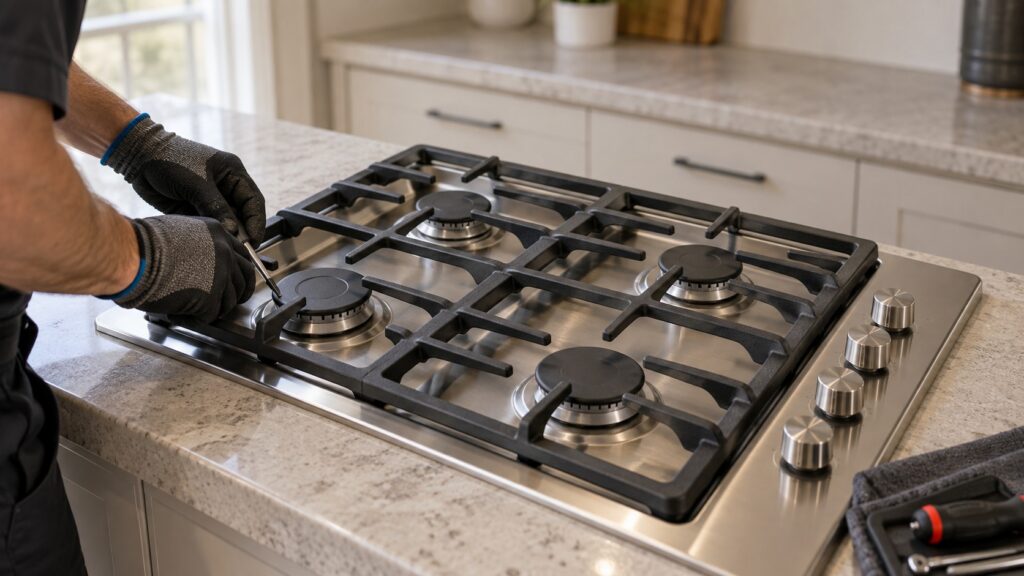
The Electrolux EW30GC55PS is a discontinued 30-inch ICON pro-style gas cooktop in stainless steel with four sealed burners, continuous cast iron grates and a Min-2-Max dual-flame burner. It is no longer in production, and most people who search the number are not shopping a showroom — they are looking at one in a listing, or living with one and wondering whether it is worth keeping. Both questions have the same answer, and it depends on the grates, the burner heads and the igniter module rather than on anything glamorous.
What is the Electrolux EW30GC55PS?
It belongs to the ICON line, the pro-style tier Electrolux built around heavy grates and a commercial look for a residential cutout. The four burners are sealed, meaning the burner base is welded into the surface so spills stay on top of the cooktop instead of running into the cabinet — the single biggest practical difference between this generation and the open-burner cooktops that came before it.
The Min-2-Max dual-flame burner is the feature owners keep. It carries two concentric flame rings, so one burner covers a hard boil and a genuine low simmer without a diffuser. The continuous cast iron grates matter just as much day to day: a heavy pan slides from one burner to the next without being lifted, which is the thing you notice within a week and miss forever afterward.
How does it compare with the EW30GC60PS and EW30GC55GS?
Three close relatives, and the number tells you which is which.
The 60PS fits a fifth burner into the same 30-inch width, which means the burners sit closer together and two large pans crowd each other. The 55GS is the earlier, plainer version without the ICON trim. And the EI30EC45KS is worth knowing about only because it shares the cutout: households replacing a gas cooktop with electric discover that the opening is the easy part and the gas line, the receptacle and the circuit are not.
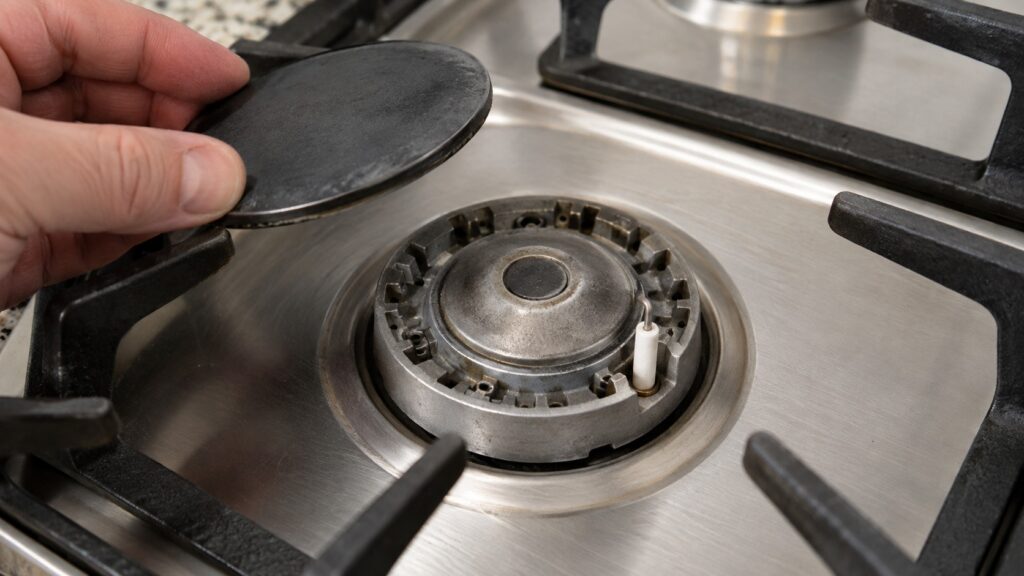
What should you check before buying one used?
- Light every burner. The flame should be blue and even all the way around the ring, and it should catch within a couple of seconds of the click.
- Turn each burner to the lowest setting and let it sit for a minute. A flame that dies at low is a clogged port or a worn valve.
- Lift the grates and the burner caps. Look for warping, pitting and rust at the cap edges — caps are replaceable, but four of them adds up.
- Check the sealed surface around each burner base for cracks or lifting, which is the one failure that ends the cooktop.
- Look underneath at the igniter wiring and the module if you can reach it. Grease and rodent damage both live there.
- Photograph the rating plate on the underside, with the model and serial number, before you leave.
Measure the cutout as well, and check what is under it. A pro-style cooktop needs clearance below for the burner box, and a shallow drawer cabinet that suited a flat electric unit may not take this one. Our cooktop installation guide covers the clearances and the gas connection.
What goes wrong on this cooktop?
The fault list for a sealed-burner gas cooktop is short and mostly mechanical. Ports clog with boil-over and carbon until a section of the ring will not light. Igniter electrodes crack or foul, so the burner clicks without catching or clicks continuously after it has lit. Spark modules fail, which takes all four burners out at once and is the version that looks catastrophic and usually is not. Valves stiffen. Caps and grates corrode, especially where a pan has boiled dry.
A burner that will not light has a diagnosis path of its own, and our guide to an Electrolux gas cooktop that will not ignite works through it from the click to the flame. Note that none of this resembles an electronic code: gas cooktops in this generation are diagnosed by symptom, while the induction and hybrid surfaces in the same catalog report codes, which is the subject of our Electrolux cooktop E8 guide.
One safety line matters more here than anywhere else on this site. If you smell gas, do not test anything. Shut off the supply valve, ventilate, leave the house, and call the gas utility before you call a repair company.
Can you still get parts for a discontinued cooktop?
For the consumable hardware, yes, and that covers most of what fails: burner caps, grates, igniter electrodes, spark modules and valve seals are still supplied for the ICON generation. The part that gets difficult is anything model-specific and cosmetic — a control knob in the right finish, a bezel, the stainless top itself. Ordering is done from the model and serial number, because the ICON line ran across several years with quiet revisions.
That shapes the keep-or-replace decision. A cooktop needing caps and an igniter module is worth repairing; a cooktop with a cracked or lifted top around a burner base is not, because the part that fails is the part the appliance is. Cast iron grates are also worth restoring rather than replacing — a soak and a careful scrub returns almost all of them.
Grates are a separate calculation. A set of continuous cast iron grates for a 30-inch pro-style cooktop is one of the more expensive accessories in the catalog, so a used unit sold with warped or badly pitted grates is worth less than the listing suggests. Weigh a set into the price before you agree to it, and inspect the underside of each grate where rust starts out of sight.
When should you call a technician?
Call when a burner will not light after the cap and ports are clean, when the clicking never stops, when a flame is yellow and lazy rather than blue, when a low setting will not hold, or when you have just installed a used unit and want the connection checked before you cook on it.
We are an independent repair company and not a factory service arm. Pricing starts from a diagnostic visit and we confirm the estimate before any work begins. Electrolux cooktop repair covers burners, valves, igniters, spark modules and controls on discontinued models as well as current ones. You can schedule a visit online or call (844) 414-1609.