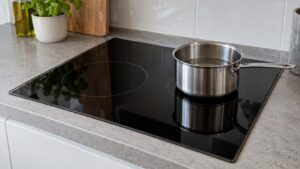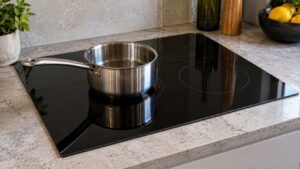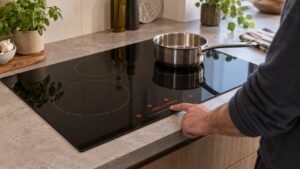
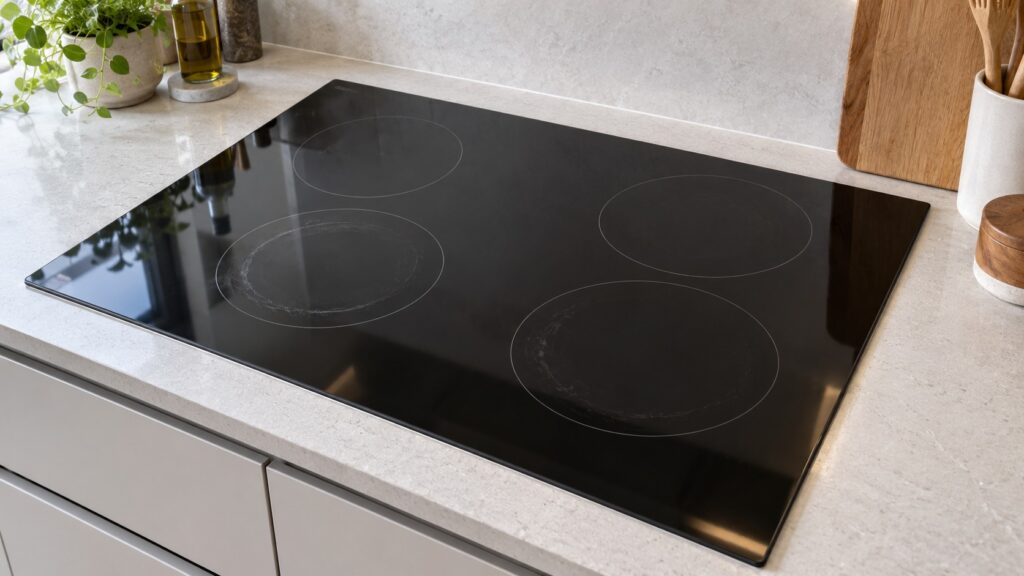
For electrolux induction cooktop how to clean questions, the short answer is: switch every zone off, let the glass cool, wipe it with a damp soft cloth, and buff it dry. Use cooktop cream and a soft pad for stuck residue, and keep liquid off the touch controls. An induction surface is easier than a radiant one because the glass is heated by the pan, not by an element underneath, so spills bake on less, but sugary spills, grit under pans and abrasive cleaners still do damage.
How is cleaning an induction cooktop different from a radiant one?
Our guide to how induction cooking works explains that a coil under the glass heats the pan directly, so the cooktop surface itself stays comparatively cool outside the area under the pan. That helps cleaning: a boil-over lands on glass that is not as hot as a radiant element, so it is less likely to bake on. The glass directly under a hot pan is still hot from the pan, so treat it as hot until it has cooled. Our glass cooktop care guide adds that radiant and induction surfaces are cleaned the same way even though they heat differently, so the routine below follows it and adds what is specific to induction.
What is the safe daily wipe?
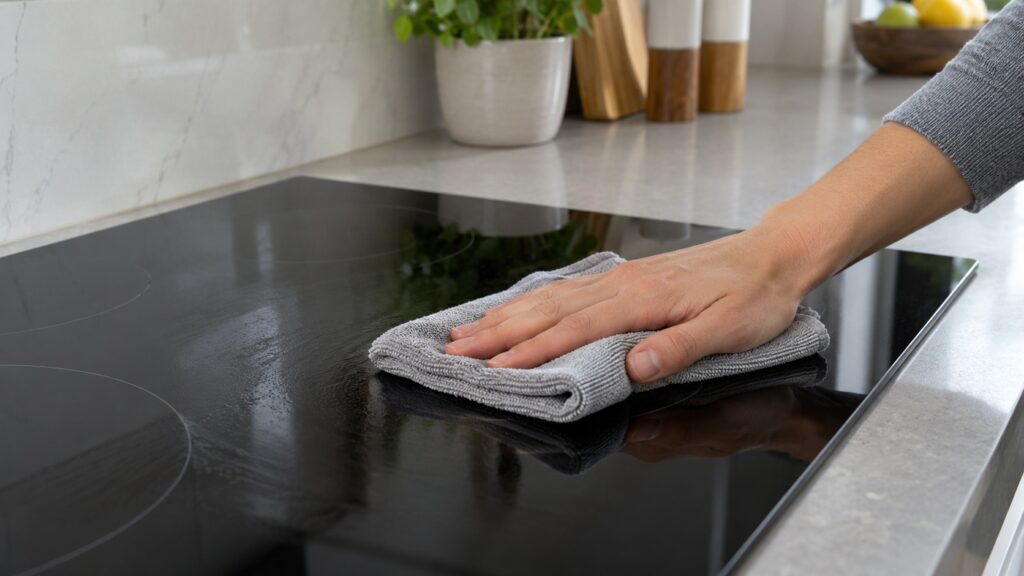
Switch every zone off, wait until the glass is warm to the touch rather than hot, then wipe with a damp soft cloth and buff dry with a clean one. Our care guide says to wipe when warm, not hot, because a damp cloth lifts almost everything at that point, and to buff dry because water left to evaporate leaves mineral marks that look like scratches. Do not put a wet cloth on a glass surface that is still hot. If a zone shows a hot-surface indicator, wait for it to go out; the exact indicator differs by model, so see your owner’s manual.
How do you remove stuck residue and pan marks?
Put a small amount of cooktop cream on a soft pad, work it over the stain and buff it off with a clean dry cloth. Our care guide describes the cream as mildly abrasive by design, which leaves a film that resists the next spill. Metal marks left by aluminum pan bases are usually removable with cooktop cream, and a cooktop scraper with a fresh blade held at a shallow angle removes burnt-on residue that a cloth will not; held upright, it scratches. Sugar is the one spill that cannot wait: our care guide says melted sugar and sugary spills pit hot glass-ceramic permanently, and explains how to push them off the glass with a scraper while the surface is still hot. Read that section before you need it. The glass is hot, so use an oven mitt and a proper cooktop scraper, and if you are not comfortable working on hot glass, switch the zone off, leave the spill and book a visit rather than risk a burn.
How do you clean around the touch controls?
Take care here, because the controls are sealed touch sensors, not knobs. Our E9 page says E9 is an internal interface error commonly triggered by liquid on the touch controls, where a spill or boil-over is read as touch input. So wipe the control area with a barely damp cloth, never pour or spray cleaner onto the cooktop, and dry the panel, including its edges and seams. Some models also have a control lock, shown as an L on the display. If the cooktop does not respond after you have wiped it, check for the lock before you suspect a fault; see your owner’s manual for how to release it on your model. If E9 appears, the page says to turn the cooktop off at the breaker for thirty seconds, clean and dry the entire control panel, then restore power; if E9 returns on a clean, dry panel, the interface board needs a technician.
What should you never use on an induction cooktop?
Scouring pads, scouring powder, bleach or chlorine cleaner and oven cleaner, plus anything labeled heavy duty that does not also say it is for glass cooktops. Do not slide pans across the glass, because grit under a pan base leaves scratches, and do not let a chip sit; our care guide warns that a chipped edge is a crack waiting for a temperature change, so stop using that zone and book a visit. Fine scratches are cosmetic but permanent. And if you cook on cast iron, lift the pan rather than dragging it.
Why does a clean pan matter as well as a clean cooktop?
A pan base with residue stuck to it deposits that residue on the glass, and it can also make the zone behave oddly. Our E1 page describes a compatibility or pan-detection failure on an induction cooktop, and one of its steps is to clean the glass surface under the pan and try again. Our induction cookware compatibility tips cover how to check pans with a magnet. If a zone still will not heat with a clean, compatible pan on clean glass, see our induction cooktop not heating guide.